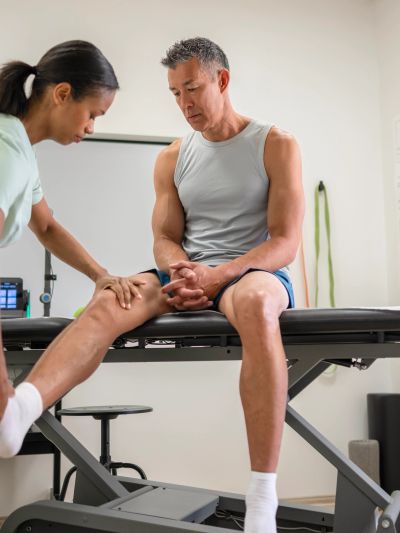
An ACL tear can feel career-ending — but with the right rehab plan, most athletes return to full sport within 9–12 months. Here's your complete roadmap.
The anterior cruciate ligament (ACL) connects the femur to the tibia and provides rotational stability to the knee. It's commonly torn in sports requiring sudden changes of direction — soccer, basketball, skiing, football — usually through a non-contact mechanism where the foot plants and the body twists.
ACL tears rarely heal on their own due to poor blood supply. Reconstruction using a graft (patellar tendon, hamstring, or cadaver tissue) is the standard approach for active individuals, though some patients — particularly older adults or those with low activity demands — may choose non-surgical management with PT alone.
📊 The Numbers
With proper rehabilitation, approximately 80–90% of athletes return to their prior level of sport after ACL reconstruction. Starting PT pre-surgery ("prehab") has been shown to significantly improve post-surgical outcomes.
Goals: Control swelling and pain, restore basic range of motion, and begin gentle quad activation. You'll work on straight leg raises, ankle pumps, ice/elevation protocols, and early weight-bearing with crutches. Swelling management is critical — poorly managed swelling inhibits the quad muscle and slows everything downstream.
Goals: Regain full range of motion, begin closed-chain strengthening, and normalize gait. Exercises include mini squats, leg press, step-ups, and hamstring curls. Stationary cycling typically begins at 4–6 weeks. The emphasis is on quality of movement, not quantity of load.
Goals: Build quad and hamstring strength toward symmetry with the uninjured leg. Single-leg exercises, balance training, and neuromuscular control drills take center stage. Most patients begin light jogging around 10–12 weeks if strength and symmetry benchmarks are met.
Goals: Running progression, cutting and pivoting drills, plyometric training, and return-to-sport preparation. This phase is often where athletes rush — and where re-injury risk is highest. Objective testing (limb symmetry index, single-leg hop tests) guides progression, not just time.
Goals: Full return to unrestricted sport participation. Clearance should be based on passing a battery of functional tests — not simply how many months have passed. Athletes who return before reaching strength and movement benchmarks face a dramatically elevated re-injury risk.
If you're planning ACL surgery, starting PT beforehand ("prehab") significantly improves your post-surgical outcomes. Stronger quads and hamstrings going into surgery mean faster recovery coming out of it. Ask us about our pre-surgical conditioning program.
Fear of re-injury is one of the most common reasons athletes don't return to sport at their previous level — even after physical clearance. Our therapists integrate psychological readiness assessment and confidence-building progressions throughout the program. Recovery isn't just physical.
ACL rehabilitation takes time — typically 9–12 months for return to competitive sport. Rushing the process dramatically increases re-injury risk, which carries consequences far worse than the original tear. Trust the process, follow your therapist's guidance, and celebrate every milestone along the way.
Our sports rehab specialists will build you a program designed for your sport, your goals, and your timeline.
Book a consultation with one of our licensed therapists today.
Revive Physical Therapy
Address: 5675 Stone Rd, Suite 200, Centreville, VA, USA
PHONE: 703-796-1300 FAX: 703-226-0550
Copyright © 2026 Revive Physical Therapy - All Rights Reserved.
We use cookies to analyze website traffic and optimize your website experience. By accepting our use of cookies, your data will be aggregated with all other user data.