Lower back pain affects millions of Americans and is one of the leading causes of missed work and reduced quality of life. The good news? Research shows that most cases respond remarkably well to physical therapy — often better than surgery or long-term medication.
clinical research is clear: for the vast majority of patients, physical therapy outperforms surgery, injections, and long-term pain medication — both in outcomes and in lasting relief.
Many patients come to us convinced they need surgery after seeing concerning words on an MRI report — "herniated disc," "disc degeneration," "stenosis." But imaging findings often don't correlate with pain levels. Studies consistently show that structural abnormalities visible on MRI are present in people with zero pain, and that conservative treatment resolves symptoms in the vast majority of cases.
💡 Did You Know?
Research published in the New England Journal of Medicine found that physical therapy was as effective as surgery for spinal stenosis and herniated disc — with fewer risks and faster return to activity.
Weak or poorly coordinated deep core muscles — particularly the transverse abdominis and multifidus — are among the most common contributors to chronic lower back pain. These aren't the "six-pack" muscles; they're the deep stabilizers that support your spine during every movement. PT exercises that retrain these muscles provide lasting structural support that no medication can replicate.
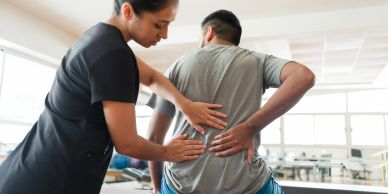
Hands-on treatment by a licensed PT — including spinal joint mobilization and soft tissue work — has strong evidence behind it for reducing acute and chronic back pain. Manual therapy improves joint mobility, reduces muscle guarding, and provides neurological pain relief that helps patients engage more fully with their exercise program.
How you move matters just as much as how strong you are. Many patients with back pain have developed compensatory movement patterns that place excess load on vulnerable structures. PT identifies and corrects these patterns — teaching proper lifting mechanics, bending, and postural habits that protect your spine for life.
Contrary to old-school advice to rest and avoid activity, current evidence strongly supports staying active and progressively loading the spine. Physical therapists design graded exposure programs that gently challenge the tissues, build capacity, and desensitize the nervous system — breaking the fear-avoidance cycle that keeps many patients stuck in chronic pain.
Understanding pain science is genuinely therapeutic. When patients learn that pain is not always a reliable indicator of tissue damage — and that the nervous system can become sensitized — anxiety decreases, activity levels increase, and outcomes improve. Our therapists spend time helping you understand your pain, not just treat it.
⚠️
While most back pain is benign, see a doctor or go to the ER immediately if you experience: loss of bladder or bowel control, numbness in the groin or inner thighs, severe pain following trauma, or pain accompanied by unexplained fever or weight loss.
Lying on your back, extend opposite arm and leg while keeping lower back flat. 3 sets × 8 reps each side.
On hands and knees, alternate arching and rounding your spine slowly. 10–15 repetitions morning and evening.
From all-fours, extend opposite arm and leg, hold 3 seconds. 3 sets × 10 reps. Excellent for multifidus activation.
Lying on back, feet flat, lift hips until body forms a straight line. Hold 2 seconds. 3 sets × 15 reps.
If your back pain has lasted more than 2–3 weeks, is interfering with daily activities, or keeps recurring, it's time to get a professional assessment. Early PT intervention leads to faster recovery, lower healthcare costs, and significantly reduced risk of developing chronic pain.
At Revive Physical Therapy, book a 30-minute initial consultations so you can meet your therapist, discuss your symptoms, and understand your options — with no obligation to commit.
Book a consultation with one of our licensed therapists today.
An ACL tear can feel career-ending — but with the right rehab plan, most athletes return to full sport within 9–12 months. Here's your complete roadmap.
The anterior cruciate ligament (ACL) connects the femur to the tibia and provides rotational stability to the knee. It's commonly torn in sports requiring sudden changes of direction — soccer, basketball, skiing, football — usually through a non-contact mechanism where the foot plants and the body twists.
ACL tears rarely heal on their own due to poor blood supply. Reconstruction using a graft (patellar tendon, hamstring, or cadaver tissue) is the standard approach for active individuals, though some patients — particularly older adults or those with low activity demands — may choose non-surgical management with PT alone.
📊 The Numbers
With proper rehabilitation, approximately 80–90% of athletes return to their prior level of sport after ACL reconstruction. Starting PT pre-surgery ("prehab") has been shown to significantly improve post-surgical outcomes.
Goals: Control swelling and pain, restore basic range of motion, and begin gentle quad activation. You'll work on straight leg raises, ankle pumps, ice/elevation protocols, and early weight-bearing with crutches. Swelling management is critical — poorly managed swelling inhibits the quad muscle and slows everything downstream.
Goals: Regain full range of motion, begin closed-chain strengthening, and normalize gait. Exercises include mini squats, leg press, step-ups, and hamstring curls. Stationary cycling typically begins at 4–6 weeks. The emphasis is on quality of movement, not quantity of load.
Goals: Build quad and hamstring strength toward symmetry with the uninjured leg. Single-leg exercises, balance training, and neuromuscular control drills take center stage. Most patients begin light jogging around 10–12 weeks if strength and symmetry benchmarks are met.
Goals: Running progression, cutting and pivoting drills, plyometric training, and return-to-sport preparation. This phase is often where athletes rush — and where re-injury risk is highest. Objective testing (limb symmetry index, single-leg hop tests) guides progression, not just time.
Goals: Full return to unrestricted sport participation. Clearance should be based on passing a battery of functional tests — not simply how many months have passed. Athletes who return before reaching strength and movement benchmarks face a dramatically elevated re-injury risk.
🏅
If you're planning ACL surgery, starting PT beforehand ("prehab") significantly improves your post-surgical outcomes. Stronger quads and hamstrings going into surgery mean faster recovery coming out of it. Ask us about our pre-surgical conditioning program.
Fear of re-injury is one of the most common reasons athletes don't return to sport at their previous level — even after physical clearance. Our therapists integrate psychological readiness assessment and confidence-building progressions throughout the program. Recovery isn't just physical.
ACL rehabilitation takes time — typically 9–12 months for return to competitive sport. Rushing the process dramatically increases re-injury risk, which carries consequences far worse than the original tear. Trust the process, follow your therapist's guidance, and celebrate every milestone along the way.
Our sports rehab specialists will build you a program designed for your sport, your goals, and your timeline.
The first six weeks after knee replacement surgery are the most critical. Learn what milestones to hit, what to avoid, and how PT speeds your return to daily life.
Physical therapy begins the day of or the day after surgery — before you even leave the hospital. This early mobilization is intentional and critically important. Getting up, bearing weight, and beginning gentle range of motion exercises reduces blood clot risk, controls swelling, and prevents the muscles from rapidly deconditionng.
Your hospital PT will help you stand, take your first steps with a walker, and begin simple ankle pumps and quad sets. These early exercises are non-negotiable for a good recovery.
🎯 Your 6-Week Goals
By 6 weeks post-surgery, most patients aim to achieve: walking without a walker or cane, bending the knee to at least 90°, minimal to no resting pain, and the ability to perform basic daily activities independently.
Focus on swelling and pain management, early range of motion, and safe mobility. Ice 20 minutes every 2 hours, elevate the leg above heart level when resting, and perform your home exercise program 2–3 times daily. Most patients use a walker at this stage. You'll begin outpatient PT within the first week of discharge.
Range of motion should be progressing toward 90° of flexion. Straight leg raises, mini squats, and stationary cycling (if range permits) are introduced. Many patients transition from a walker to a cane during this period. Swelling should be noticeably decreasing, though some is normal for months.
Most patients are walking without an assistive device or with minimal use of a cane by week 6. Stair climbing with a more normal pattern, light strengthening exercises, and increasing walking distance are the focus. Driving typically resumes around week 6 (right leg replacement) pending physician clearance.
❄️
Ice is your best friend in the first 6 weeks. Applying ice for 20 minutes before and after exercise sessions and throughout the day dramatically reduces swelling, which in turn reduces pain and allows better motion. Never ice directly on skin — always use a thin cloth barrier.
Stiffness and scar tissue: If range of motion is not progressing, your PT may use manual techniques including patellar mobilization and soft tissue work to prevent scar tissue from limiting your final outcome.
Quad weakness: The quadricep muscle often shuts down after knee surgery due to swelling and pain signals. Neuromuscular electrical stimulation (NMES) combined with exercise is highly effective for re-activating these muscles.
Swelling that won't resolve: Some swelling is normal for 3–6 months. However, sudden increases in swelling, redness, or warmth should be reported to your surgeon promptly as these can indicate infection or blood clot.
The 6-week mark is just the beginning. Full recovery from total knee replacement — including the return of strength, endurance, and confidence — typically takes 3–6 months, sometimes up to a year. Our therapists will continue progressing your program toward your specific goals, whether that's returning to golf, hiking with your grandchildren, or simply walking the grocery store pain-free.
Start PT before surgery to improve your outcome. We offer pre-surgical conditioning and seamless post-surgical recovery programs.
Hours of screen time are reshaping how we hold our heads. "Tech neck" is causing an epidemic of neck pain and headaches — but targeted PT exercises can reverse the damage.
Your head weighs roughly 10–12 pounds in a neutral position. For every inch your head shifts forward from its ideal alignment over your shoulders, the effective weight load on your cervical spine increases dramatically — up to 60 pounds at a 60-degree forward tilt. That's the equivalent of carrying a 7-year-old child on your neck all day.
Over time, this excessive load causes the muscles at the back of the neck to become chronically overworked and tight, while the deep cervical flexors at the front become weak and inhibited. The joints of the upper cervical spine take on compressive forces they weren't designed to sustain.
📱 The Screen Time Problem
Studies show that text neck affects over 75% of the global population and is now one of the leading causes of neck pain in adults under 40 — a demographic that historically had very low rates of cervical spine problems.
You may be experiencing tech neck if you have:
Sitting tall, gently draw your chin straight back (not down). Hold 5 seconds, repeat 10×. This is the single most effective exercise for cervical alignment.
Place a rolled towel behind your shoulder blades. Gently extend over it for 30–60 seconds. Restores upper back mobility lost from desk posture.
Lying on your back, nod your chin slightly as if saying "yes." Hold 10 seconds × 10 reps. Reactivates the inhibited muscles at the front of the neck.
Arms at 90° in a doorframe, lean forward gently. Hold 30 seconds × 3. Opens the pecs and reverses the rounded shoulder pattern.
Screen height: The top of your monitor should be at or slightly below eye level. Laptop users should use an external keyboard and raise the screen.
Phone habit: Bring the phone to eye level instead of lowering your head to the phone. It feels awkward at first — that's normal.
The 20-20-20 rule: Every 20 minutes, take a 20-second break to look at something 20 feet away and reset your posture.
If you've been dealing with tech neck symptoms for more than a few weeks, or if you're experiencing arm symptoms (tingling, numbness, weakness), it's time for a professional assessment. A physical therapist can identify the specific joints and muscles involved, provide hands-on treatment to relieve compression and restore mobility, and build a targeted exercise program beyond what general advice can offer.
Don't wait for a chronic problem to develop from what started as a postural habit.
Our therapists specialize in postural assessment and cervical rehabilitation. Let's build you a plan.
You don't need an hour at the gym to protect your body. Our therapists designed a science-backed 10-minute morning mobility routine that most patients can do in their living room.
Your body has been in one position for 6–8 hours while you sleep. Joints are relatively stiff, muscles are cool, and your postural muscles haven't been asked to do much. Moving first thing in the morning lubricates joint surfaces with synovial fluid, warms up the tissues, and activates the neuromuscular pathways you'll rely on all day.
Doing this consistently also creates a habit anchor — tying movement to something you already do every morning makes it far more likely to stick than trying to squeeze it in later in the day.
🔬 The Science
A study in the Journal of Orthopaedic & Sports Physical Therapy found that athletes who performed daily injury prevention exercise programs had a 50% lower injury rate than those who didn't — regardless of sport or fitness level.
Perform each exercise in sequence. No equipment needed — just a mat or carpeted floor.
Lie on your back with knees bent. Take 5 slow, deep diaphragmatic breaths — inhale for 4 counts, exhale for 6. This activates the parasympathetic nervous system, reduces morning cortisol, and sets up proper intra-abdominal pressure for the exercises that follow. Don't skip this step.
Sit with both knees at 90° angles in front and behind you. Lean forward over the front shin. 60 seconds each side. Targets hip internal and external rotation — the most commonly neglected joint mobility in adults.
Side-lying, knees stacked, rotate top arm open to the ceiling following with your eyes. 10 reps each side. Restores the spinal rotation needed for healthy movement in virtually every sport and daily activity.
From a lunge position, place same-side hand inside front foot, rotate the other arm to the ceiling. 5 reps each side. This single movement addresses hip flexors, thoracic spine, ankle, and groin simultaneously.
On your back, feet flat, drive hips to the ceiling squeezing glutes at the top. 15 reps. Activates the posterior chain and counters the hip flexor dominance that develops from prolonged sitting.
Standing, make slow, large circles with one arm — taking the shoulder joint through its full available range with muscular control. 3 forward, 3 backward each side. CARs maintain joint health and detect restriction before it becomes pain.
Stand on one foot for 30 seconds each side, eyes open. Progress to eyes closed as balance improves. Single-leg balance is one of the strongest predictors of lower extremity injury risk — and one of the easiest things to train.
Week 1–2: Master the basic movements with full attention to form.
Week 3–4: Add light resistance (resistance band) to the glute bridge and increase hold times on balance work.
Month 2+: Add a 2-minute segment of sport-specific or activity-specific movement preparation tailored to what you're doing that day.
This routine was designed to address the most universal movement deficiencies — hip mobility, thoracic rotation, glute activation, and balance. However, if you have a history of specific injuries or chronic pain, your routine should be personalized.
Our physical therapists offer movement assessments that identify your specific weaknesses and restrictions, then build a targeted routine that addresses your individual risk profile. Five minutes of the right movements beats twenty minutes of generic stretching every time.
The most important variable in any injury prevention program is consistency. Ten minutes every day outperforms 60 minutes twice a week. Set a reminder, put your mat out the night before, and commit to the habit — your future self will thank you.
Our therapists will identify your specific risk factors and build a routine designed for your body and your goals.
We accept most major insurance plans so you can focus on your recovery without worrying about the cost.
Revive Physical Therapy
Address: 5675 Stone Rd, Suite 200, Centreville, VA, USA
PHONE: 703-796-1300 FAX: 703-226-0550
Copyright © 2026 Revive Physical Therapy - All Rights Reserved.
We use cookies to analyze website traffic and optimize your website experience. By accepting our use of cookies, your data will be aggregated with all other user data.