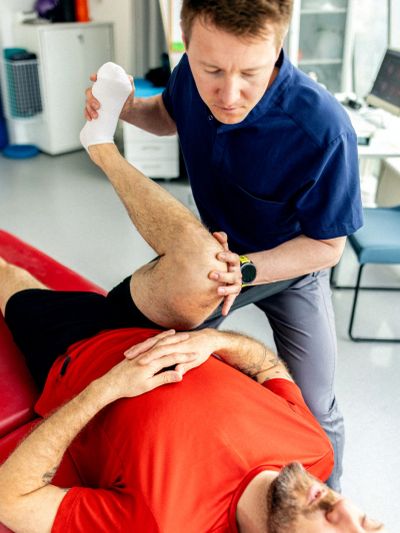
The first six weeks after knee replacement surgery are the most critical. Learn what milestones to hit, what to avoid, and how PT speeds your return to daily life.
Physical therapy begins the day of or the day after surgery — before you even leave the hospital. This early mobilization is intentional and critically important. Getting up, bearing weight, and beginning gentle range of motion exercises reduces blood clot risk, controls swelling, and prevents the muscles from rapidly deconditionng.
Your hospital PT will help you stand, take your first steps with a walker, and begin simple ankle pumps and quad sets. These early exercises are non-negotiable for a good recovery.
🎯 Your 6-Week Goals
By 6 weeks post-surgery, most patients aim to achieve: walking without a walker or cane, bending the knee to at least 90°, minimal to no resting pain, and the ability to perform basic daily activities independently.
Focus on swelling and pain management, early range of motion, and safe mobility. Ice 20 minutes every 2 hours, elevate the leg above heart level when resting, and perform your home exercise program 2–3 times daily. Most patients use a walker at this stage. You'll begin outpatient PT within the first week of discharge.
Range of motion should be progressing toward 90° of flexion. Straight leg raises, mini squats, and stationary cycling (if range permits) are introduced. Many patients transition from a walker to a cane during this period. Swelling should be noticeably decreasing, though some is normal for months.
Most patients are walking without an assistive device or with minimal use of a cane by week 6. Stair climbing with a more normal pattern, light strengthening exercises, and increasing walking distance are the focus. Driving typically resumes around week 6 (right leg replacement) pending physician clearance.
Ice is your best friend in the first 6 weeks. Applying ice for 20 minutes before and after exercise sessions and throughout the day dramatically reduces swelling, which in turn reduces pain and allows better motion. Never ice directly on skin — always use a thin cloth barrier.
Stiffness and scar tissue: If range of motion is not progressing, your PT may use manual techniques including patellar mobilization and soft tissue work to prevent scar tissue from limiting your final outcome.
Quad weakness: The quadricep muscle often shuts down after knee surgery due to swelling and pain signals. Neuromuscular electrical stimulation (NMES) combined with exercise is highly effective for re-activating these muscles.
Swelling that won't resolve: Some swelling is normal for 3–6 months. However, sudden increases in swelling, redness, or warmth should be reported to your surgeon promptly as these can indicate infection or blood clot.
The 6-week mark is just the beginning. Full recovery from total knee replacement — including the return of strength, endurance, and confidence — typically takes 3–6 months, sometimes up to a year. Our therapists will continue progressing your program toward your specific goals, whether that's returning to golf, hiking with your grandchildren, or simply walking the grocery store pain-free.
Start PT before surgery to improve your outcome. We offer pre-surgical conditioning and seamless post-surgical recovery programs.
Revive Physical Therapy
Address: 5675 Stone Rd, Suite 200, Centreville, VA, USA
PHONE: 703-796-1300 FAX: 703-226-0550
Copyright © 2026 Revive Physical Therapy - All Rights Reserved.
We use cookies to analyze website traffic and optimize your website experience. By accepting our use of cookies, your data will be aggregated with all other user data.